The obligatory readings in ENG 110 are designed to provide a new perspective on how I perceived literature and literacy. At the beginning of the semester, The very first reading introduced to our class was “Mother Tongue”, by Amy Tan in which the primary focus of Amy’s argument is towards society’s expectations of proper English. Often, framing the language that her mother uses is part of the variations of different “Englishes.” In essence, this first reading set the stage for what was to come, including addressing the imperfections in English learning. This was later reiterated in another paper read during class, which dealt with revisions as we worked on the final draft of our Language and Literacy essay at the time. The two readings in question were a nod to make the work of writing a “Final Draft” less stress-inducing, removing the aspect of English being all perfect at the final stage in publication. However, the part in those readings that stuck with me personally is when they discussed how many times a book had to be rewritten before publication or how many major or minor details were taken into account. In exploring these new perspectives, it inspires me to think differently when writing and encourages positive affirmations in writing English.
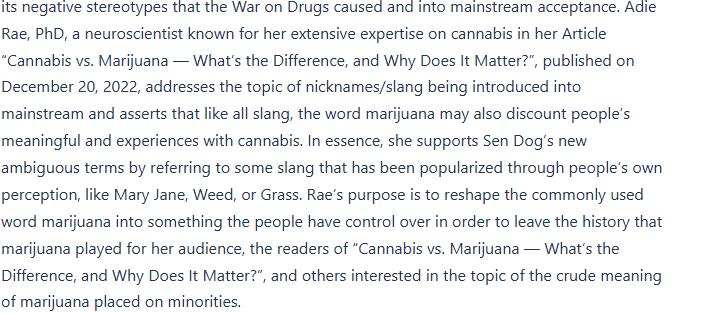
In academic writing, the 2 sentence rhetorical summary offers me easy access to integrating sources while still crediting the source. As someone who tries to avoid using the conventional “According to…” or the many other introductions to citing, I find myself strictly paraphrasing in my work and ending with an APA format. It got even worse when, during the last year of high school, this was praised heavily, making the 2 sentence summary more impactful. While I still quoted and paraphrased most of my Synthesis Essay, I was able to integrate a rhetorical summary that included all credits, addressing the argument, Adie’s purpose, and her intended audience.
Being exposed to the SIFT strategy had an attentive outcome for my Synthesis Essay, which built off an understanding of biases when researching a topic and determining if something can be misinformation. I’d first noticed the natural biases when it comes to investigating a topic. Through the “SIFT strategy assignment,” where we either chose a topic we were going to research for the synthesis essay, or a new topic we’re interested in at the moment. In my case, I’d chosen to research the popular question about whether cats would eat their owner if they were to become deceased. I’d wondered this because I was a new cat owner.
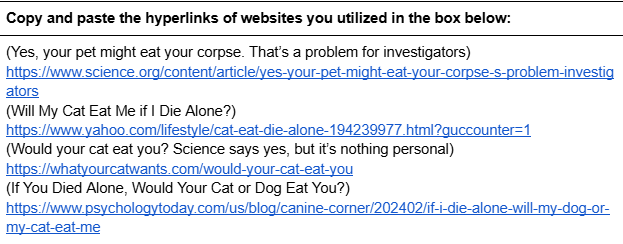
Using the SIFT(Stop, Investigate, FInd, and Trace) method to to analyze the following inks, I’d come to the consensus that most of these links were talking about cats specifically, or talking about pets in general, with the cat links less inclined to mention domesticated animals, giving rise to falsehoods about cats. So when it came to the Synthesis Essay, I knew to keep guard, especially since cannabis is a highly debated topic. To determine if a source was reputable, I made sure that any site I considered was supported by at least three other articles presenting the same information before deciding to use it. For example, Adie Rae, PhD, in her Article “Cannabis vs. Marijuana — What’s the Difference, and Why Does It Matter?”, a source I referenced a lot, had a work cited that I was able to look at to see where the info was used to construct this informative site.
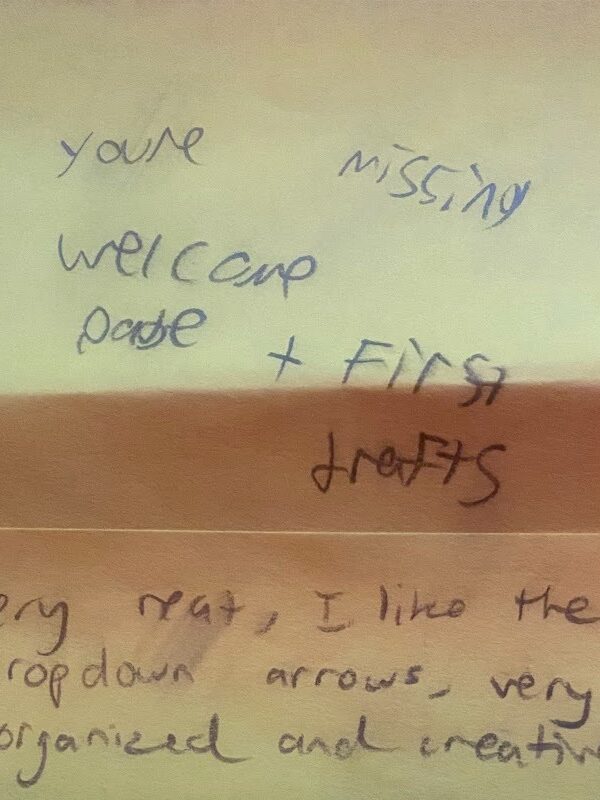
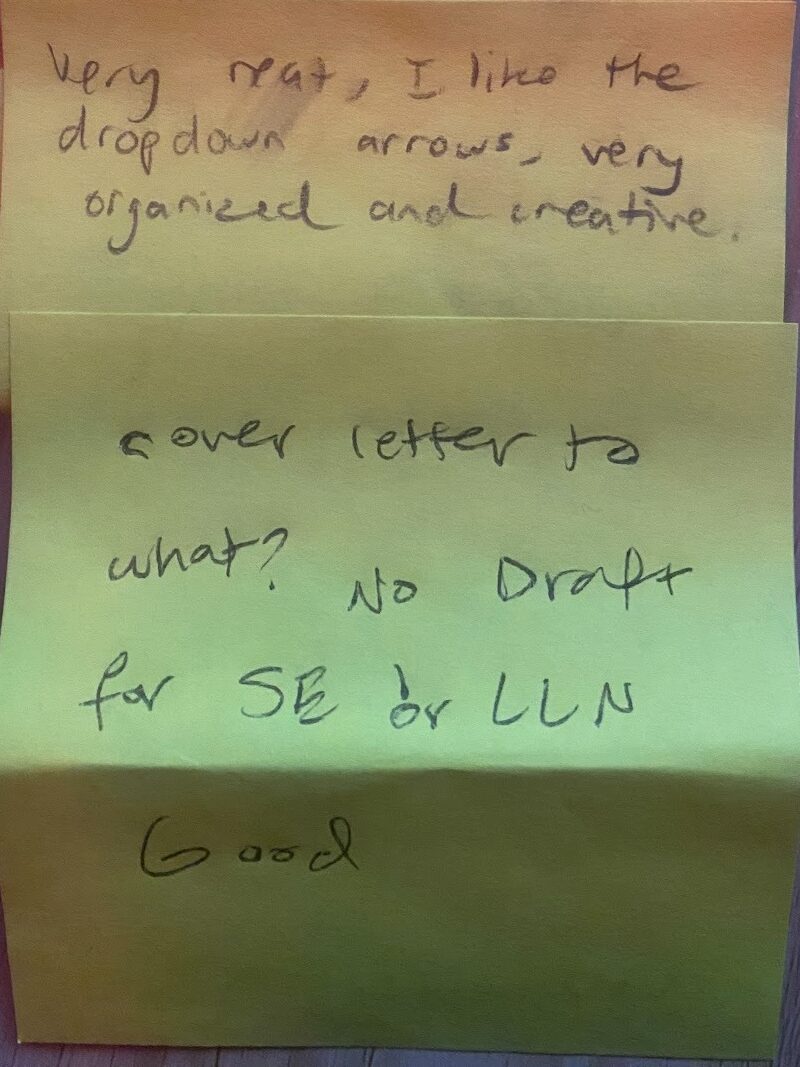
The in-person peer reviews didn’t offer any real advice for my English growth or final papers. While reviewing in general is helpful, like the mandatory writing center visit for the LLN narrative, it was insightful. I’d been given feedback on how I should focus back into my own experiences rather than just retelling a story about someone else, which while I was there, I didn’t know it seemed like that. I took this verbal constructive feedback by adding new sentences for my introduction, adding “struggling with schoolwork” into my narrative, and then realizing different household customs. Intrinsically, the opinion of other sources has a different perspective. Nevertheless, once peer reviews were around the corner, everyone saw it as just an assignment and had nothing meaningful to contribute during peer review. This leads to students being nitpicky, as seen in the Translation 2 gallery. For my portfolio, all pages were available on my site, but I received two Post it notes about missing drafts. I now realize this may have been a publishing error, as it was not clear that the tabs were clickable. I later fixed this by changing the hover link color. It’s also a user error, though. Other than those comments they didn’t really comment on the content, overall aesthetic, usability, and readability, aside from one student.
The in-person peer reviews didn’t offer any real advice for my English growth or final papers. While reviewing in general is helpful, like the mandatory writing center visit for the LLN narrative, it was insightful. I’d been given feedback on how I should focus back into my own experiences rather than just retelling a story about someone else, which while I was there, I didn’t know it seemed like that. I took this verbal constructive feedback by adding new sentences for my introduction, adding “struggling with schoolwork” into my narrative, and then realizing different household customs. Intrinsically, the opinion of other sources has a different perspective. Nevertheless, once peer reviews were around the corner, everyone saw it as just an assignment and had nothing meaningful to contribute during peer review. This leads to students being nitpicky, as seen in the Translation 2 gallery. For my portfolio, all pages were available on my site, but I received two Post it notes about missing drafts. I now realize this may have been a publishing error, as it was not clear that the tabs were clickable. I later fixed this by changing the hover link color. It’s also a user error, though. Other than those comments they didn’t really comment on the content, overall aesthetic, usability, and readability, aside from one student.