Over the last two decades, cannabis has been a major topic of discussion in legal reform in several countries, especially the U.S. It has many recreational terms that might be more familiar, like Marijuana, which is often interchangeable with cannabis due to many misconceptions. Several people narrowly view cannabis as merely a psychedelic hallucinogen unfit for recreational use, stemming from its roots in deeply influencing this narrative. For clarification, Cannabis refers to a family of plants, most of which “mainly contain cannabidiol(CBD), an active ingredient in FDA-approved epilepsy medication”( Adie Rae, 2022). The over the counter use is that “people tend to use CBD for things like anxiety, stress relief, or nerve pain” ( Adie Rae, 2022). The other types of cannabis plants the public is used to seeing scrutinized are “the plant that contains the chemical tetrahydrocannabinol (THC), well known for its ability to make people feel high”(Adie Rae 2022). While it appears as if these definitions would be in consideration of its legality for recreational use, it’s actually about the state’s own jurisdiction to qualify what is and what isn’t permitted based on the levels of THC cannabis can have. Finally, it should be understood that this multifaceted conversation, without question, adds to prejudices against minority groups with its first appearance in criminalizing Cannabis.
Before the first major state even considered the introduction of legalization, Cannabis was heavily criminalized by the simple phrase “War on Drugs”. The first person to utter this phrase was Henry Anslinger, a “Well known figure for his racist beliefs that were documented in his speeches”(Adie Rae, 2022). Initially, this is where the misconception between Cannabis and Marijuana started. Referring to Cannabis as the “Mexican-Spanish world Marihuana makes it seem like a foreign threat, which was pushing the agenda to specifically target minority groups”(Adie, 2022). Later adopted by president Nixon and his administration for the same purpose. This was a direct contradiction to what “President John F. Kennedy and Vice President Lyndon Johnson commissioned reports that found that marijuana did not induce violence or lead to the use of other, more dangerous drugs”(Brittany Tackett, Jul 31, 2025). Their commission report is dated before the mountains of propaganda that flooded the 1970s to 2000s, and in changing perspectives on Cannabis, people were rightfully associating it with harder drugs like opioids and heroin, which are leagues away in terms of addiction. Drug arrests increased from 580,000 in 1980 to 1.7 million in 2003; in 1984, they represented 6.1% of all arrests, while in 2003 they were 12.3%(Crime in the United States, 2003, Washington, DC:FBI). The “War on Drugs” was not only successful in its efforts to criminalize minorities, but it also began another separate problem in overpopulation of jail. Years of incarceration compared to what we now consider a small offense. Building on this fundamental understanding, It’s necessary to examine the transition towards decriminalizing/legalizing cannabis.
Now, to get the conversation that most people think of when legalizing Cannabis, recreational use. Recreational use has so much traction, but why is that? It can all be traced to our early media, hippies, and “denim-clay heavy metal kids”(Anthony Pappalardo, 2023). Marijuana usage was almost retro, and even though people still did it regularly, it wasn’t trendy, and wearing a “pot leaf” T-shirt was the easiest way to brand yourself a “stoner loser”(Anthony Pappalardo, 2023). That was until the pivot of the “West Coast gangster rap group adorned their debut LP with a skull adorned with a pot leaf and changed hip-hop” (Anthony Pappalardo, 2023). Since hip-hop was the most prominent genre during the mid-1980s to 2000s, an album that was not only good for its time caused a chain reaction of speaking freely about marijuana. One of the artists in the group, Sen Dog, even spoke in an interview, saying, “We just wanted to make it cool again. After the War on Drugs that the Reagans had, when they classified marijuana as a Class One drug, it made it really uncool and made parents really concerned about smoking weed” (Anthony Pappalardo, 2023). The artists alone had the power to generate a culture shift that helped to redefine the use of marijuana, moving it away from its negative stereotypes that the War on Drugs caused and into mainstream acceptance. Adie Rae, PhD, a neuroscientist known for her extensive expertise on cannabis in her Article “Cannabis vs. Marijuana — What’s the Difference, and Why Does It Matter?”, published on December 20, 2022, addresses the topic of nicknames/slang being introduced into mainstream and asserts that like all slang, the word marijuana may also discount people’s meaningful and experiences with cannabis. In essence, she supports Sen Dog’s new ambiguous terms by referring to some slang that has been popularized through people’s own perception, like Mary Jane, Weed, or Grass. Rae’s purpose is to reshape the commonly used word marijuana into something the people have control over in order to leave the history that marijuana played for her audience, the readers of “Cannabis vs. Marijuana — What’s the Difference, and Why Does It Matter?”, and others interested in the topic of the crude meaning of marijuana placed on minorities.
Sixteen years after the initial medical Cannabis state law was passed, Colorado made history by “legalizing cannabis for adults over age 21”(Colorado, September 03, 2025). “A little over a year later, on January 1, 2014, retail stores opened their doors”(Colorado, September 03, 2025). Cannabis is one of those drugs that is so easily accessible to people that it is a big task to get it off the streets. In this regard, why not just tax marijuana? Colorado, in campaigning for the vote for recreational use, used this as an opportunity to tax marijuana instead, because of the sheer amount of revenue that marijuana produces.
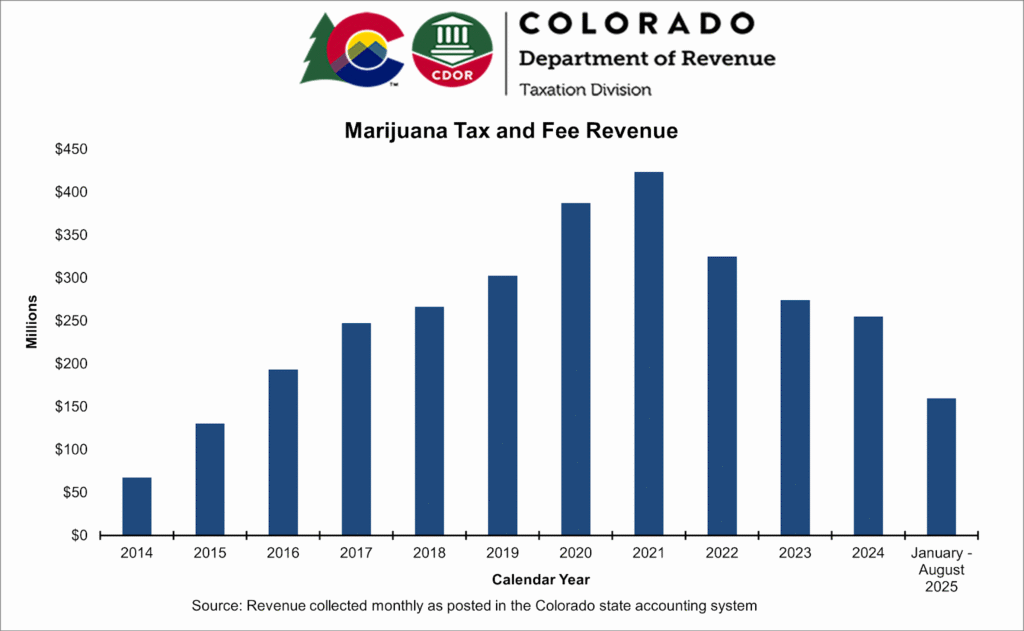
Colorado’s graph on marijuana tax revenue rose steadily after legalization and peaked in 2020-2021. The surge during those years with the COVID-19 pandemic, when heightened stress and anxiety led many people to increase their cannabis use, or rather, the taxation of medical marijuana as a source to combat COVID-19. Buying it through a source of government that can provide extra tax revenue, helping fund Colorado’s involvement in improving its areas, just solidifies that it’s undoubtedly a win-win scenario for both the consumer and the state.
From the beginning of the criminalization of marijuana, public opinion has shifted dramatically till the end. “In 1969, only 12% supported legalization, but by 2001, that number had risen to 34%, representing over 77 million adults. If these trends continued, supporters of legalization were projected to become the majority by around 2010” (“Legalization” October 25, 2025). And it shows. It had all seemed that the stigma of cannabis slowly reinvented itself to a progressive approach, where it is not only just a drug “cool people use” but can be someone’s escape from the stresses life brings them. Despite it still being debatable whether legalization is the best for society, it doesn’t highlight when it was at its worst in terms of discrimination. For this reason, it is imperative to understand the history of a significant topic like this to grasp the root cause.

